


The Maasai Mara is teaming with life and there is so much to be seen! Enjoy these photos of the “Big 5” that we sighted all in just one day!
1. Leopard
2. Leopard tracks (We chose to include this photo instead of another lion pic, because we spoiled you with lions below!)
3. African Cape buffalo (Do you see the ostrich off in the distance?)
4. Rhino
5. Elephants


Our amazing luck in the Mara continued when we spotted not one, but 3 different leopards. Leopards are very elusive cats and extremely rare to spot (no pun intended). If you do a simple “Google Images” search of a leopard, you will see that nearly all photo results are of leopards taken in captivity. Those that are taken in the wild tend to be fuzzy or obstructed by trees or vegetation. Leopards lead a solitary lifestyle and spend much of their time resting high and camouflaged in trees. They often drag their prey into a well-foliaged tree to protect it from hyenas or other scavengers.
It is no exaggeration to say we were extremely blessed to spot not one, but THREE leopards. Furthermore given the numerous cheetahs we saw as well, we were able to conduct an observational comparative study of cheetah vs. leopard. Of course, Mwalimu Wilson insisted we use the Swahili terms: duma vs. chui.
Cheetah (Duma)
· slender body & small head
· solid rounded spots
· tear marks on face
· white tuft on end of tail
· flexible spine
· non-retractable claws
· rarely climb trees
· hunt only during the day
· only eats fresh prey
Leopard (Chui)
· massive build
· rosette spots
· broad head
· black tuft on end of tail
· retractable claws
· strongest climber of all big cats
· hunt mostly at night
· will eat prey killed by another animal


The Maasai Mara is a place of many unbelievable sights and sounds. We stayed in the Porini Lion camp at Olare Orok Conservancy and it more than lived up to its name. During our stay there, we saw 16 adult lions and 14 lion cubs. Olare Orok Conservancy has the highest concentration in Africa of resident lions living in its 20,000 acres – more than 120 of them! We photographed and filmed them hunting, feeding, basking in the sun, sleeping, playing with cubs, cleaning wounds, roaring warnings to other prides, and we were even fortunate enough to catch the VERY rare sight of them mating!
Terri woke up around 3:30 one morning to the silhouette of a male lion against our tent. It quickly moved on as a Maasai warrior shined his torch and “encouraged” it on its way. The next morning she asked the camp manager at breakfast, “Was I hallucinating or was there a lion outside of our tent last night?” He nonchalantly responded, “Last night was a busy night with many visitors – a lion, hippos, monkeys, an elephant, and few hyenas. Nothing much to worry about.” “Ok then!” Terri replied wide-eyed as she cut a bite of her fresh mango and strawberry filled crepe. JoAnn and Ellen giggled nearly simultaneously, “T.I.A., baby! This is Africa!”


Our friends in Amboseli bid us farewell, grasping Henderson water bottles and waving goodbye. We all shared many hopes and promises to return next year. We were given gifts to bring back to our students as a “thank you” from the community for the beautiful animal adaptation books. We were overwhelmed with gratitude!
We hopped a plane to the Maasai Mara and were off to our next adventure. As we touched down, a “journey” of giraffes welcomed us gracefully striding across the open savannah. We exited the plane and another delightful surprise awaited us. We were greeted by the familiar friendly face of Wilson Pere who traveled from Mara Porini to Porini Lion (a considerable distance) just to be our “mwalimu” in the Mara.
He picked up right where we left off last year with a Swahili and Maa linguistics quiz for Terri and Danielle. ELL “professor” Mwalimu Naramat (Danielle) aced with flying colors, however Special Education teacher Mwalimu Nasarian (Terri) scraped by, causing Mwalimu Wilson to demand Terri take out her journal and begin necessary review. A very diligent student, Terri obliged. She did get her revenge later and taught Wilson a bit of her own “native tongue”. Unfortunately, Wilson became quickly proficient in this very particular way of speaking, resulting in many humorous exchanges.
An excerpt from Terri’s journal below…
Swahili –
“Jambo. Habari yako?” “Hello. How are you?”
“Mwzuri sana.” “Very fine.”
“Asanti sana” “Thank you very much!”
Maa –
“Sopa” “Hello. How are you?”
“Yupa” “Fine.”
“Ashe Oleng” “Thank you.”


Gamewatcher’s Safaris/ Porini Camps once again outdid themselves by organizing a special trip to the local Maasai school, Iloirero Primary. We have been in conversation with Porini and local leaders in the Maasai community over the past year about the possibility of expanding the V.I.P. partnership to include a Maasai School. So, this special visit was a true honor.
Upon our arrival, the headmaster greeted us, teachers invited us into classrooms, and students welcomed us with an outdoor assembly. We saw first hand that the teachers and children take their school motto seriously: “Education is Wealth”.
The Porini camps have recently installed solar electricity in the Iloirero School. With Kevin on our team, we were delighted to be able assess the possibility of bringing internet access and computer technology to this rural school. We see the next phase of V.I.P. as a connection between the rural and urban environments. As you can see from previous posts, Maasai life is a strong contrast to life in Nairobi. A cultural exchange between the urban Nairobi school and the rural Amboseli school through virtual connectivity could be an enriching experience to both groups of students. We are excited to see how the next phase of V.I.P. will unfold!


Photo 1 – Mt. Kilimanjaro
Photo 2 – lake July 2010
Photo 3 – lake July 2011
The concept of “global warming” is one that often times seems aloof or abstract. In fact, we sometimes wonder whether or not it is truly fact or fiction. However, for the team it was an absolute “eye opener” and deeply humbled us to see the visible changes in the Amboseli region from last year to this year. Before arriving, Danielle and Terri told the others about a lake, teaming with dozens of species of birds near the airstrip. This is where during their 2010 safari, they spent at least the first hour taking notes and photographing many types of water fowl - including spoonbills, flamingoes, Egyptian geese, yellow-billed storks, ibis, dikkops, and so on.
We were all laughing and joking remembering Danielle and Terri’s enthusiasm for the small animals when there were so many large stunning creatures to be seen. As we neared the site, Jonah pointed out to us what was left of this former oasis. We were all silenced in a pensive moment of disbelief as we viewed the conditions with a total disappearance of all birds. We could not believe what we were witnessing.
All water in the area flows from underground rivers sourced by the glacier atop Mt. Kilimanjaro. Roughly 75 years ago, the entire Amboseli region was completely covered in water. Interestingly, Mt. Kilimanjaro gets its name from Tanzania’s Chaga people., meaning “white mountain”. “Kili” means “mountain” and “majaro” means “white”. Three hundred or so years ago, Kilimanjaro was completely covered in ice and snow. To look at Kili today, you can see the rapid glacial depletion due to global warming.
In just one short year, we could not believe the dramatic difference in the landscape. It is estimated that Kilimanjaro’s glacier will be the first in the world to melt completely. We were deeply saddened by the fact that the plight of the Amboseli region is most likely irreversible. The realities of the fact of global warming are astounding when you look at the dramatic differences in the photos of the same area from July 2010 to July 2011. Sadly, global warming isn’t fiction.
We all felt a deep sense of responsibility to better teach our students about the ways in which their actions and choices can impact our planet.


“Experiential learning” took on a whole new meaning, as Ellen and JoAnn got down and dirty in Amboseli. This was truly the outdoor classroom come to life. As we traveled the 12,000 acres of the conservancy, Ellen collected indigenous and non-indigenous plant samples for her fellowship learning and fifth grade Science lessons. Both JoAnn and Ellen carefully examined, photographed, and catalogued animal tracks, scat, and bones. Once again our knowledgeable Maasai guides, Jonah and Emmanuel, provided useful information which will enhance our Science curriculum school-wide.

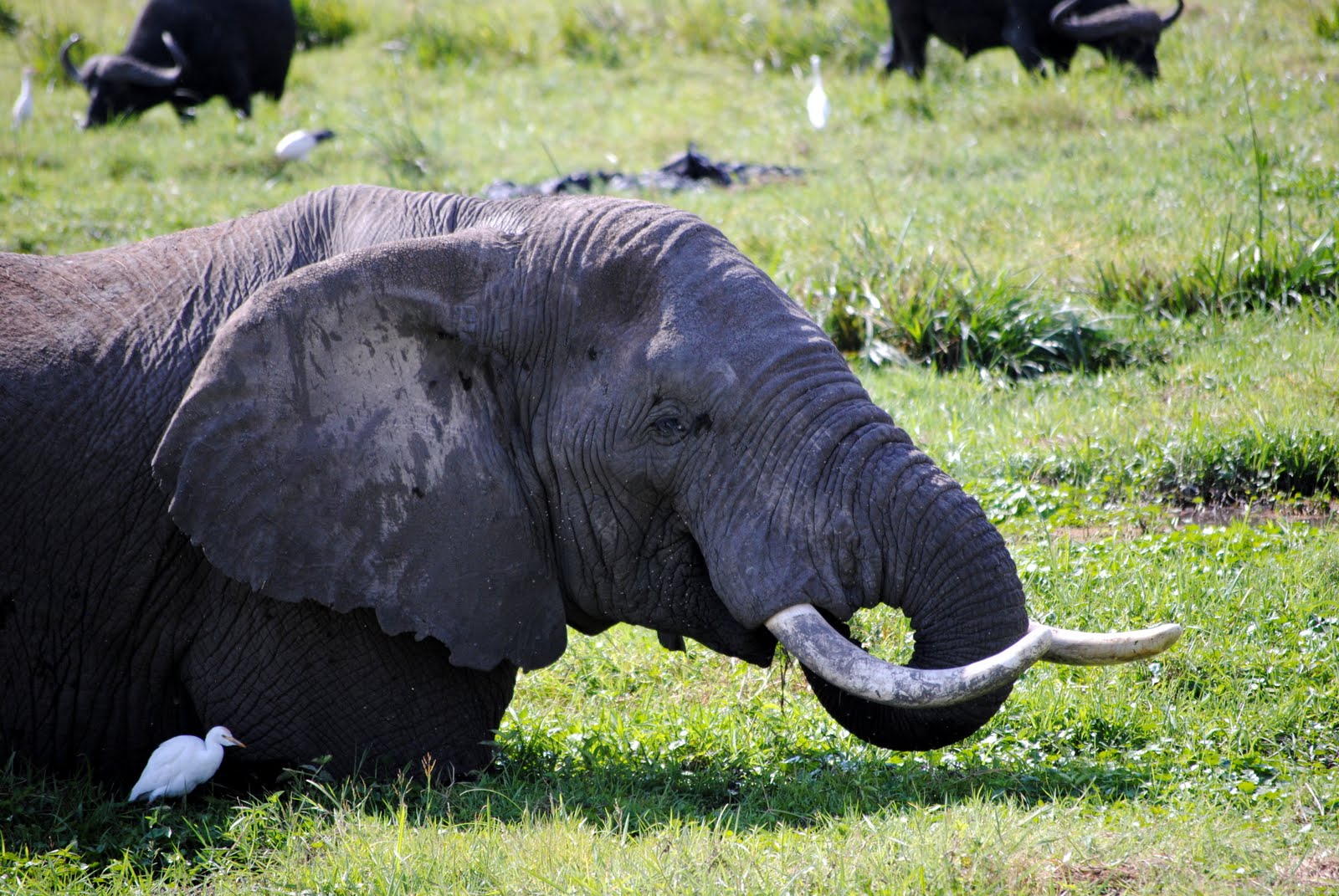


If you want to see elephants roaming in their natural habitat, Amboseli is the place to go. The park is home to about 1,600 elephants, including 58 families and hundreds of independent adult males. Over the last 40 years, Amboseli’s elephants have been protected from ivory poaching. In many other parts of Africa, poaching has destroyed the social life and family structure of elephants by eliminating older males and females. However, in Amboseli this is not the case. It is the source of data collection on elephants’ social and reproductive patterns. It was wonderful for us to have the opportunity to see these magnificent creatures “up close and personal”.
The tallest of all African animals, the giraffe wanders without a voice, communicating through eye contact and non-verbal gestures. Giraffes feed on the top layer of acacia trees. It is not uncommon to find the “giraffe neck” antelope, called the gerenuk feasting below perched on hind legs and leaving the lower layer for the smallest of all antelope, the dik dik.
Enjoy these beautiful photos of some of our favorite Amboseli animals.


